Engine ground runs (EGRs) play a vital role in the heavy maintenance of military and civil aircraft.
Conducted before and after intrusive work on systems and structures, they ensure safety, reliability and readiness during maintenance and prior to delivery.
This article provides insights into EGRs for the C-130J Super Hercules, explaining their purpose and walking through the main steps of a typical test schedule.
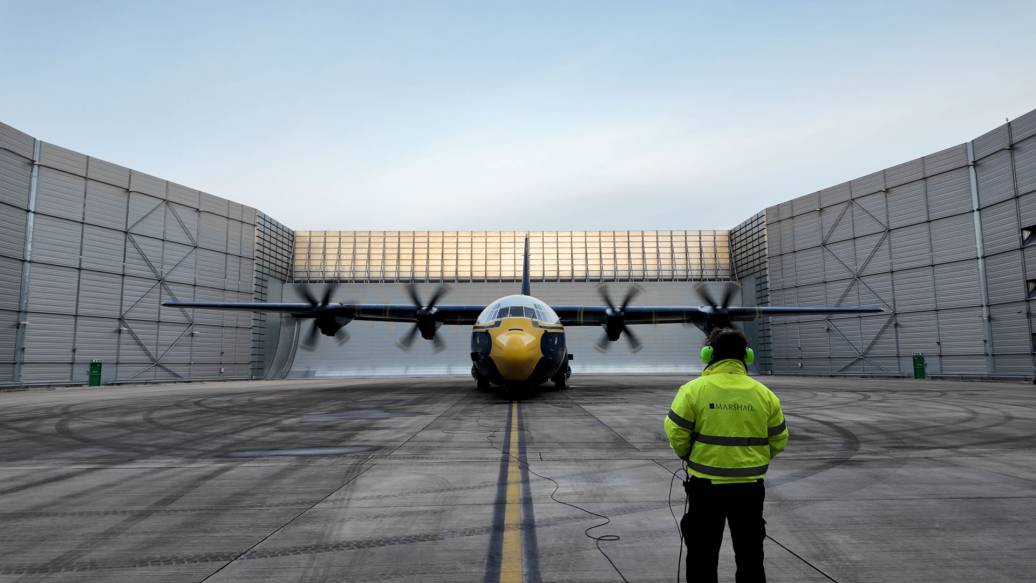
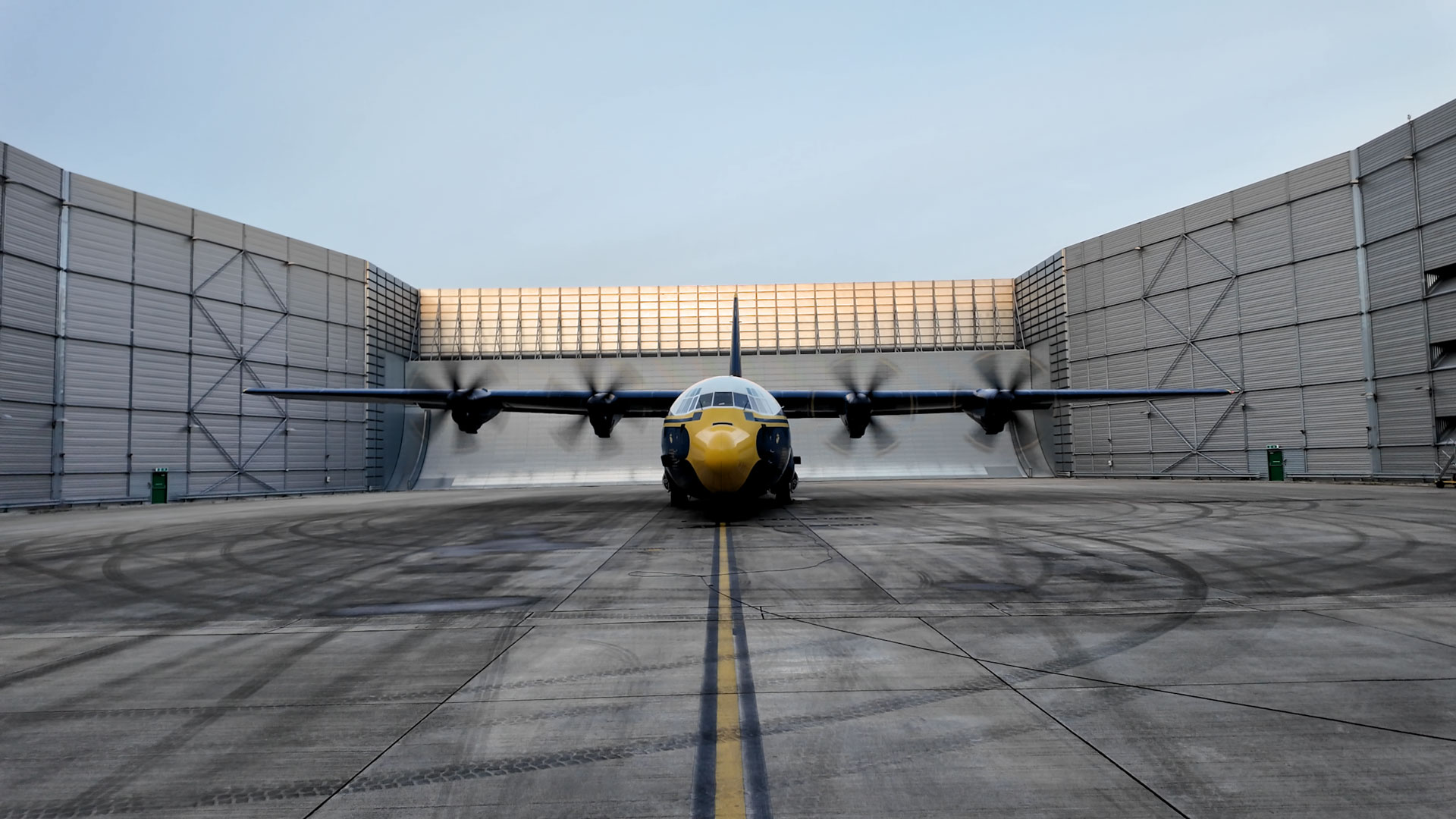
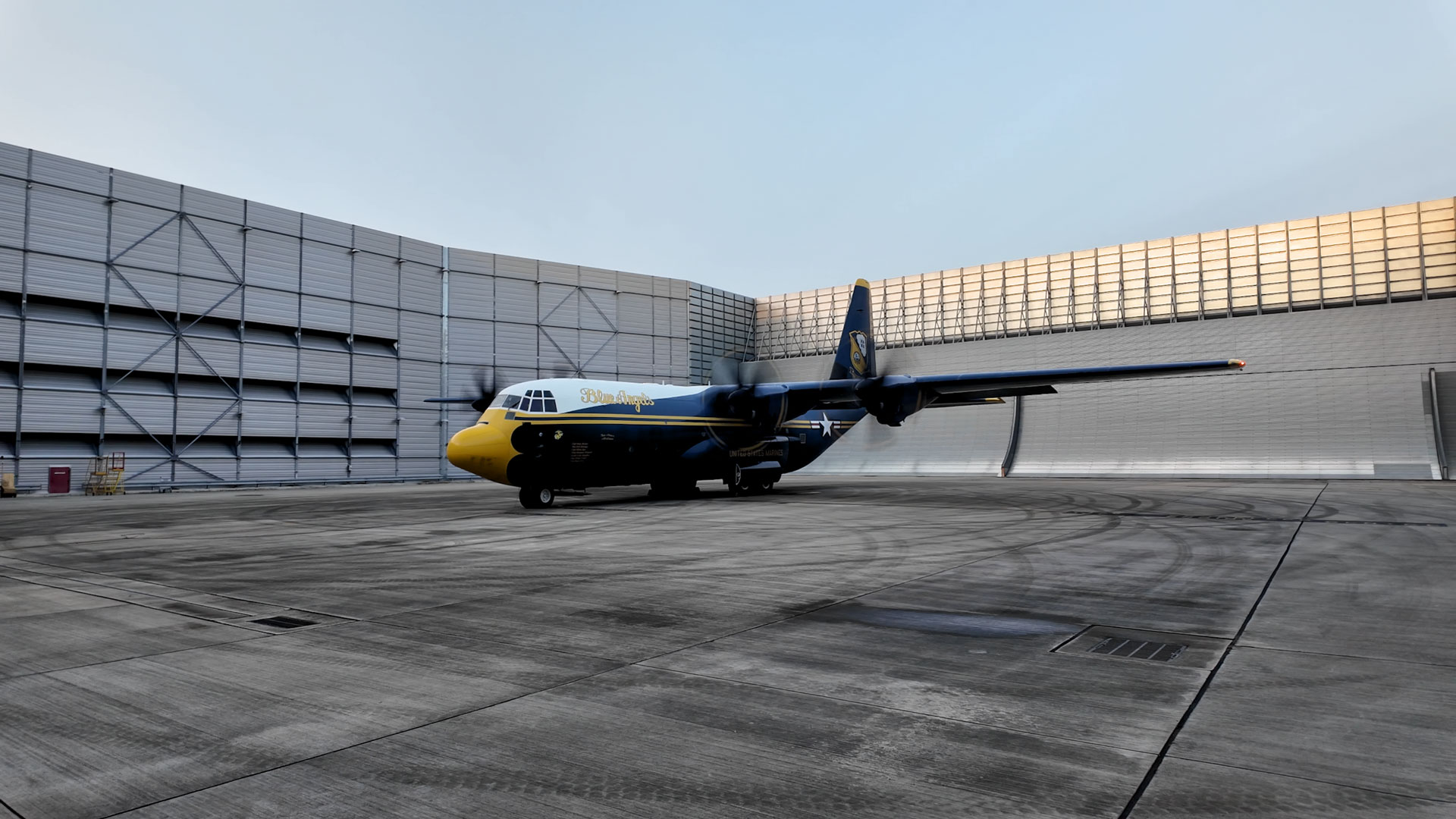
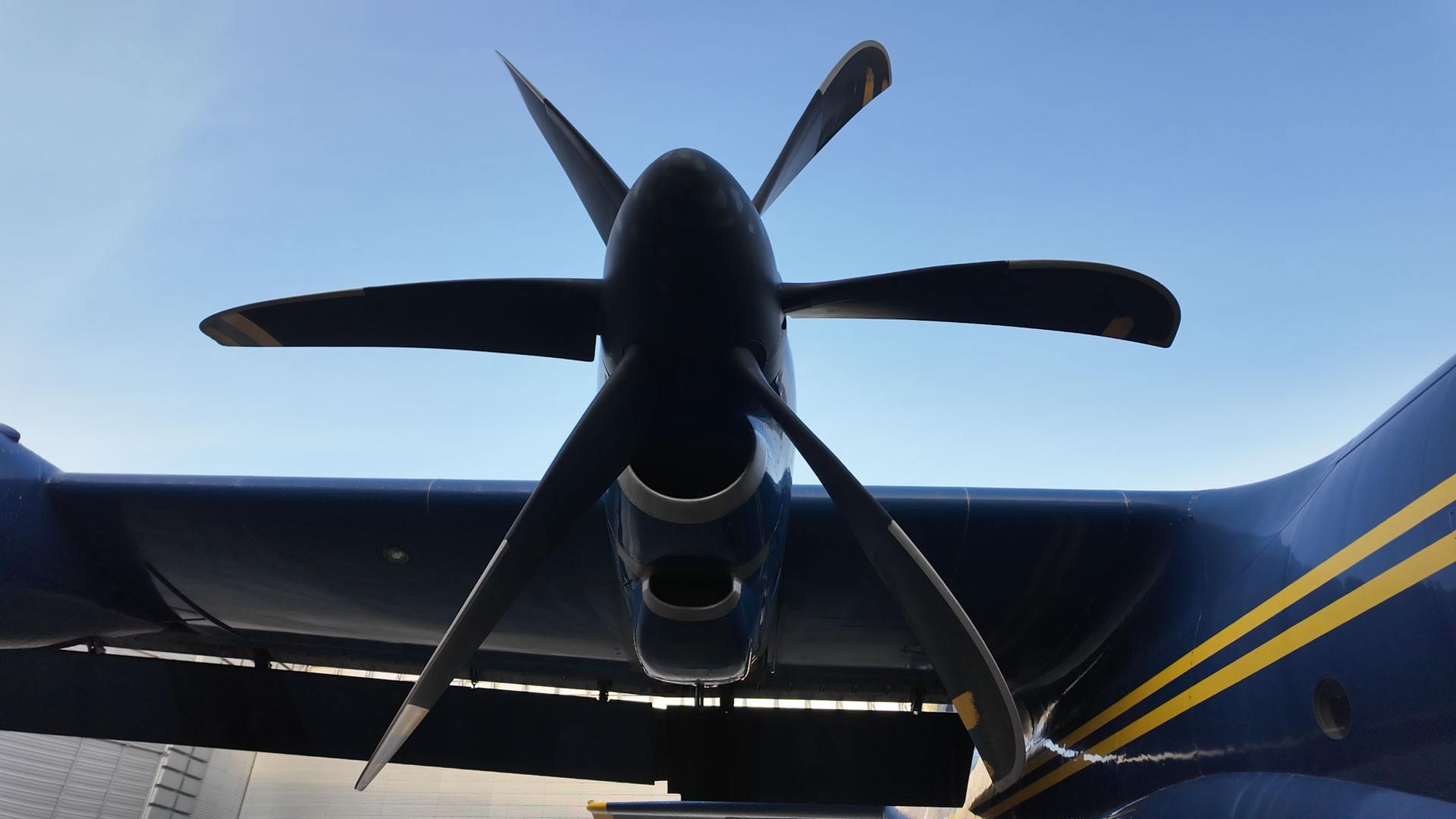
The video accompanying this article was shot in Marshall’s state-of-the-art ground running enclosure in Cambridge, UK, and shows a pre-maintenance EGR being performed on Fat Albert, the iconic support aircraft operated by the US Navy’s Blue Angels flight demonstration squadron.
Types of EGR
EGRs conducted by Marshall Aerospace and other MRO specialists fall into two main categories: pre-maintenance EGRs and post-maintenance EGRs.
While both types both follow largely identical pre-established procedures, their purposes are quite different.
Pre-maintenance EGRs
Pre-maintenance EGRs are performed shortly after an aircraft has been inducted and initial inspections have taken place, but before any more invasive work has begun.
The chief purpose of a pre-maintenance EGR is to establish an initial performance baseline for the aircraft. Running the engines under controlled conditions enables real-world observation of system behaviours, assessment of engine functions, and evaluation of engine parameters. This ensures the aircraft’s systems are serviceable, while also providing points of comparison for technicians to refer to once maintenance is complete.
Pre-maintenance EGRs also provide a chance to confirm or diagnose faults that have been reported by the aircraft’s operator, especially when these cannot be investigated through static inspections. In such cases, EGRs help the maintenance organisation and the customer make evidence-based decisions regarding the scope and nature of required maintenance.
An additional function of pre-maintenance EGRs is to help purge old oil from the aircraft’s engines and ensure that clean oil has been circulated throughout at regular operational temperatures. This supports the broader process of engine inhibition, which reduces the risk of internal corrosion or contamination during a potentially lengthy period in storage.
Post-maintenance EGRs
Post-maintenance EGRs are conducted to verify that maintenance actions have been completed correctly and that the aircraft is safe to fly. They are generally the final functional checks to take place before flight testing, since they provide a controlled means of risk reduction by identifying faults while the aircraft is on the ground.
This is often particularly important when maintenance work has disturbed the engine, propellers, fuel system or any associated controls, or when systems have been replaced or modified. Post-maintenance EGRs are often run several times until error codes and potential faults have been successfully resolved.
The EGR test sequence
Most EGRs follow a standardised sequence, ensuring consistent, repeatable checks regardless of aircraft or maintenance activity.
Preparation and checks
The aircraft is brought into Marshall’s ground running enclosure (the largest of its kind in Europe), and secured with chocks and brakes. Clear zones are established to protect personnel and equipment, and fire cover, communications and emergency procedures are confirmed.
Startup and stabilised idle
Engines are started one by one in a pre-defined sequence. In the case of the C-130 Hercules, it is customary to start engine 3 first, followed by 4, then 2, and finally 1.
Once running, each engine’s throttle is held at the low-speed ground idle setting, allowing temperatures and pressures to settle while speed, vibration levels and instrument indications are checked.
Function checks
Once the technicians are satisfied with ground idle performance, they upshift one engine at a time to high-speed ground idle to conduct a series of functional checks, including anti-icing, propeller blade feathering, and FADEC (Full Authority Digital Engine Control) response.
The engines are then returned to low-speed ground idle.
Throttle operation
In order to check engine operation at all power settings, the technicians advance the throttle of each engine from the lowest power position through to the highest. On a C-130J, this entails starting at low-speed ground idle and moving through high-speed ground idle and “over the gate” to flight idle, maximum continuous, and then take-off. The engines are also run at the maximum reverse throttle setting.
Each Rolls-Royce AE 2100D3 engine onboard the C-130J is capable of producing up to 4,700 shaft horsepower. Despite the fact that the aircraft is operating on the ground and restrained by brakes and chocks, this stage of the EGR process still causes considerable movement, as can be seen in the accompanying video.
To prevent excessive or uncontrollable movement, the throttle shifts are performed in symmetrical inboard and outboard pairs: for example, while two engines are running at the maximum reverse setting, the other two are kept at flight idle to prevent the nose wheels from lifting off the ground.
Once the technicians are satisfied that a thorough throttle operation test has been conducted, all engines are returned to low speed ground idle and shut down in sequence.
World-leading EGR expertise and facilities
EGRs at Marshall Aerospace are conducted fully in-house by technicians who are also directly involved in maintenance within the hangars.
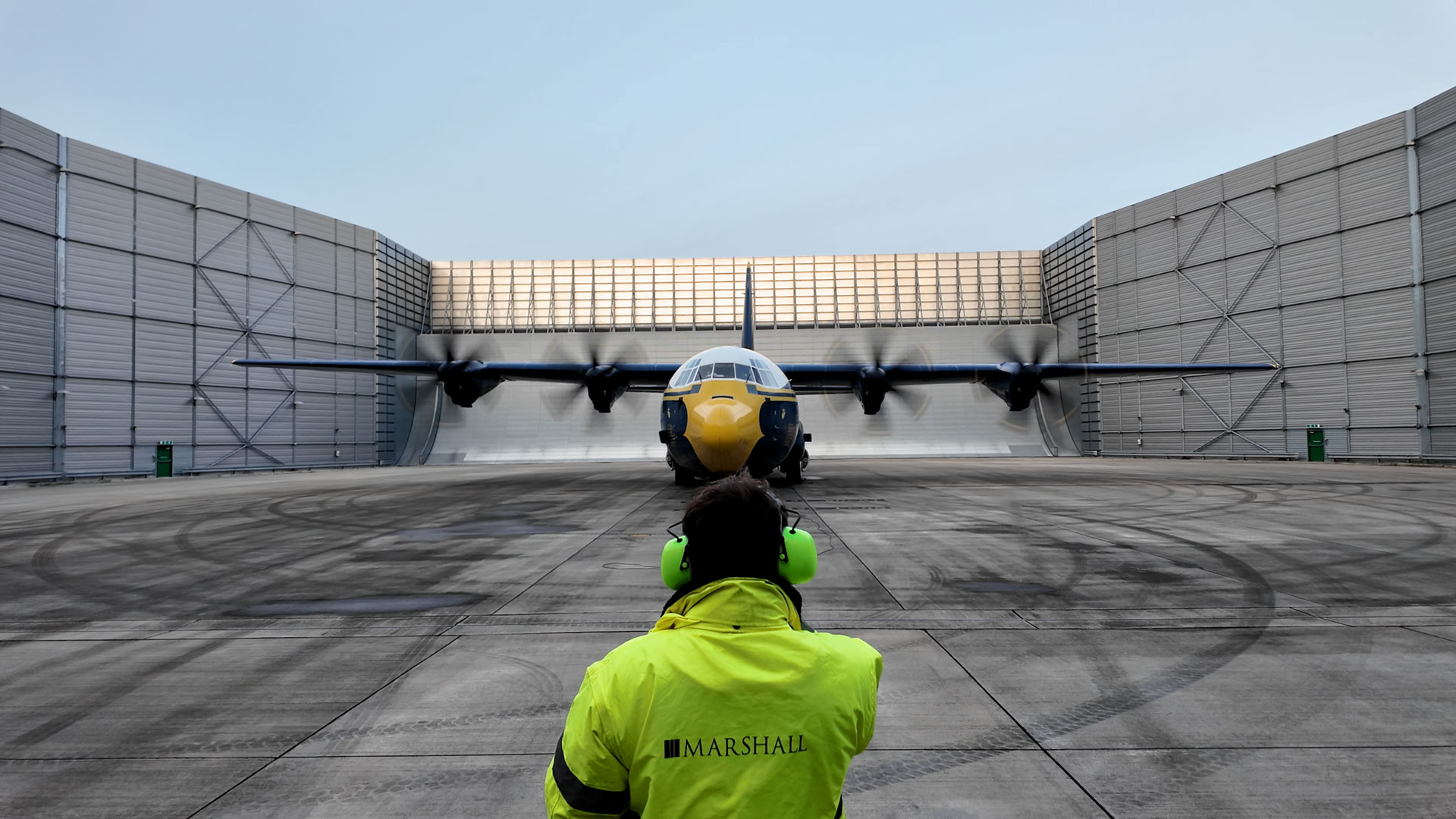
The company fields a team of individuals with the specific training and qualifications required to operate the aircraft’s throttles and brakes; in order to maintain the currency of these qualifications, they must exceed a certain threshold of EGR hours on a regular basis.
Outside the aircraft, EGRs are managed by run supervisors, safety observers and (where appropriate) fire crew, in addition to the ground crews responsible for towing and securing the aircraft.
Marshall maintains the largest ground running enclosure in Europe, measuring 90m wide and 20m high. The facility, which was constructed by Blast Deflectors, Inc. and began operations in 2019, is designed to enable conditioning of the airflow to the propellers or jet engine intakes, while significantly reducing noise generated by the EGR process.
Find out more about Certification and Testing at Marshall Aerospace
Fat Albert EGR: extended cut
This video below shows practically the entire pre-maintenance EGR sequence for Fat Albert, from start to finish.
The footage has not been edited (with the exception of several minor cuts) in order to provide a true behind-the-scenes experience and demonstrate the power and range of the C-130's engines, as well as showing the test schedule followed by Marshall's engineers and technicians.