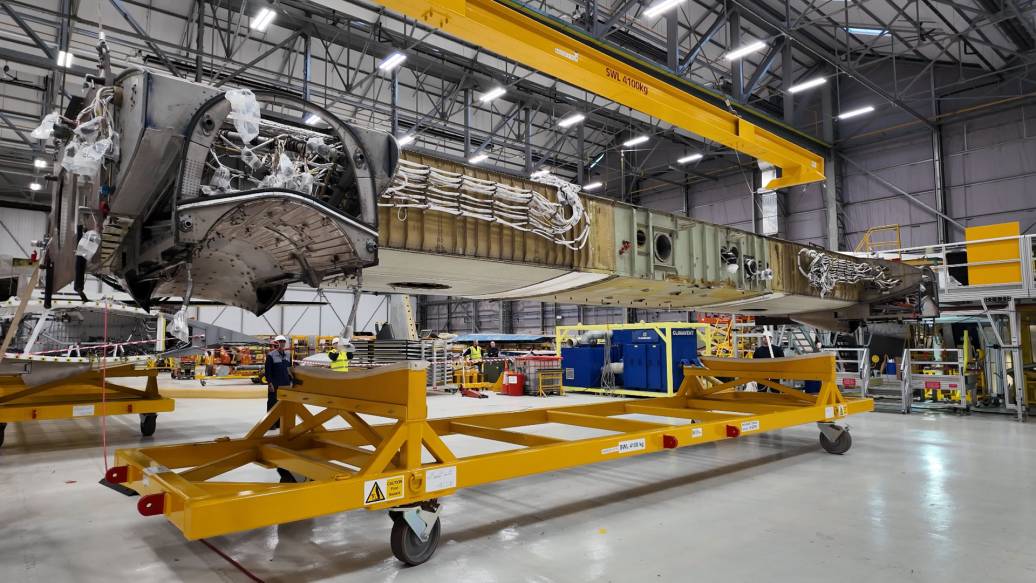
Replacing a centre wing box is a complex, multi-stage structural maintenance process carried out to extend the useful life of a C-130 Hercules.
The centre wing box is a critical part of the aircraft’s primary structure, connecting the outer wings to the fuselage and carrying major loads during flight. Once it passes its age and fatigue limits, the aircraft can no longer be flown.
Before a brand new centre wing box can be installed, the existing structure must be carefully separated and removed. This process is often compared to spinal surgery: a carefully controlled operation requiring specialist infrastructure, detailed preparation, deep experience and considerable care.
The video below shows the steps and equipment involved in removing a centre wing box at Marshall Aerospace in Cambridge. The aircraft being filmed is Fat Albert, the US Navy’s C-130J support aircraft for the Blue Angels.
Preparing for removal
Before the centre wing box can be lifted from the aircraft, the surrounding structure must be carefully prepared.
Engines are removed and inhibited to protect them from corrosion or contamination while in storage. The outer wings are also taken off the aircraft and placed onto dedicated trolleys, clearing access to the centre section.
The aircraft is then moved into Marshall’s proprietary staging and secured in place. Before work continues, detailed laser scans are taken to confirm its alignment and positioning to tolerances of fractions of an inch.
Separating the structure
The centre wing box is systematically separated from the fuselage by removing fasteners, sealant, interfacing structures, wiring and pipework.
By this stage, the aircraft is effectively a carefully supported fuselage structure, held securely in place while one of its most important structural sections is released.
Specialist jacks are used from underneath to apply upward force, working on flooring specially reinforced with steel plates. Around 10 tonnes of force is applied to help release the centre wing box from the fuselage, with the aircraft secured to custom-engineered tie-down points to prevent movement and absorb the load.
The process is slow and methodical, with very little room for error when dealing with primary aircraft structure.
Once the centre wing box is free, its full weight is transferred to an overhead gantry crane. It is then moved clear of the aircraft and lowered safely alongside the work area.
Preparing for rebuild
Removal gives Marshall’s engineers full access to the surrounding interfacing structure.
After many years in service, this area can show cracking, corrosion, warping or wear. Each defect must be inspected, assessed and repaired before the new centre wing box can be installed.
Depending on the condition of the aircraft, this follow-on work can take several months.
As a Lockheed Martin-approved Centre of Excellence for C-130 centre wing box replacements, Marshall Aerospace combines specialist infrastructure, proven processes and decades of Hercules experience to carry out this work in-house.
The result is a C-130 prepared for many more years of service — helping operators extend aircraft life, maintain fleet availability and keep a proven platform ready for future missions.
FIND OUT MORE ABOUT MAINTENANCE, REPAIR AND OVERHAUL AT MARSHALL AEROSPACE